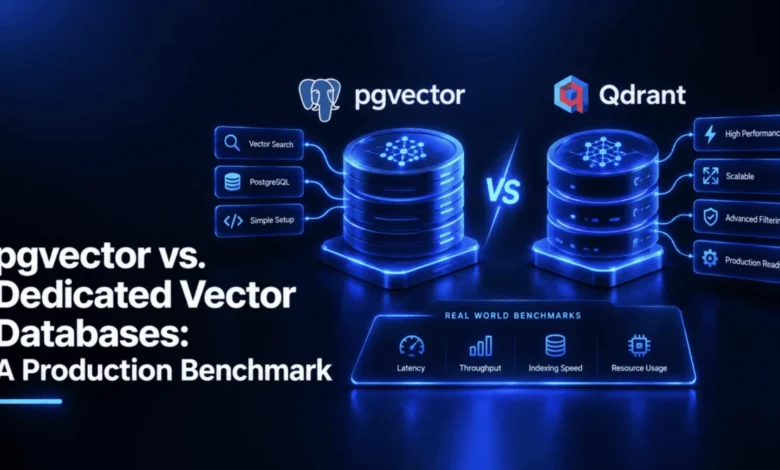
The rapid ascent of Large Language Models (LLMs) and Retrieval-Augmented Generation (RAG) has forced a critical architectural decision upon engineering teams worldwide: where to store and query vector embeddings. For many, the journey begins with an existing PostgreSQL instance, where adding the pgvector extension is a trivial exercise in modernization. However, as production workloads scale, these teams are frequently approached by vendors touting the superior performance of "purpose-built" vector databases. This debate, often fueled by marketing narratives rather than empirical data, creates a significant technical dilemma. By examining the operational mechanics, local benchmarks, and large-scale performance metrics, we can clarify which infrastructure strategy is appropriate for specific enterprise requirements.
The Evolution of Vector Search in Relational Databases
PostgreSQL has long served as the bedrock of enterprise data architecture. The introduction of the pgvector extension—which enables vector similarity search directly within the relational engine—represented a paradigm shift. Version 0.8.6, the current iteration, supports PostgreSQL 13 and later, offering native vector data types and indexing methods such as HNSW (Hierarchical Navigable Small World) and IVFFlat.
From an operational standpoint, pgvector offers the distinct advantage of "data locality." Because vector embeddings exist within the same table as relational records, developers can perform complex filtering and similarity searches in a single SQL query. This eliminates the need for maintaining synchronization between two disparate systems, reducing infrastructure overhead, network latency, and the complexity of maintaining data consistency across services.
The Rise of Dedicated Vector Infrastructure
In contrast, dedicated vector databases—such as Pinecone, Qdrant, Weaviate, Milvus, and ChromaDB—are engineered from the ground up to handle high-dimensional vector data. These systems utilize specialized storage engines and indexing algorithms designed to optimize the "nearest neighbor" search problem.
- Pinecone operates as a fully managed, zero-setup service, abstracting away the underlying infrastructure for teams prioritizing speed-to-market.
- Qdrant, built on Rust, offers high-performance query execution with advanced support for complex JSON payloads.
- Weaviate distinguishes itself with AI-native features, including built-in vectorization and hybrid search capabilities.
- Milvus provides a distributed architecture capable of handling billion-scale datasets, often utilizing GPU acceleration to handle extreme throughput.
- ChromaDB remains the standard for local prototyping and rapid iteration in Python-heavy environments.
The architectural trade-off is clear: by moving to a dedicated database, organizations sacrifice the convenience of a unified data model in exchange for specialized performance tuning, distributed scaling capabilities, and, in many cases, a managed service layer that removes the burden of database administration.
Empirical Analysis: The Local Benchmark
To understand the practical performance delta, one must simulate a production environment. By utilizing a Docker-based test harness, developers can compare pgvector against Qdrant using a standardized set of 100,000 vectors with 1,536 dimensions (matching OpenAI’s text-embedding-3-small).
In a local environment, both systems perform adequately, with latencies residing in the low single-digit millisecond range. However, these results are largely influenced by hardware-specific variables, such as CPU cycles and available RAM. At this scale, the difference between a generalized relational database and a specialized vector engine is negligible. The data suggests that for applications with fewer than 5 million vectors and moderate concurrency, the operational simplicity of pgvector is an overwhelming advantage.
Performance at Scale: Insights from Industry Benchmarks
When evaluating production-grade requirements, one must look toward larger datasets. Recent benchmarking studies, such as those conducted on 50 million Cohere embeddings, provide a more granular view of performance. In these tests, which utilized high-memory AWS r6id.4xlarge instances, the results reveal a nuanced performance landscape.
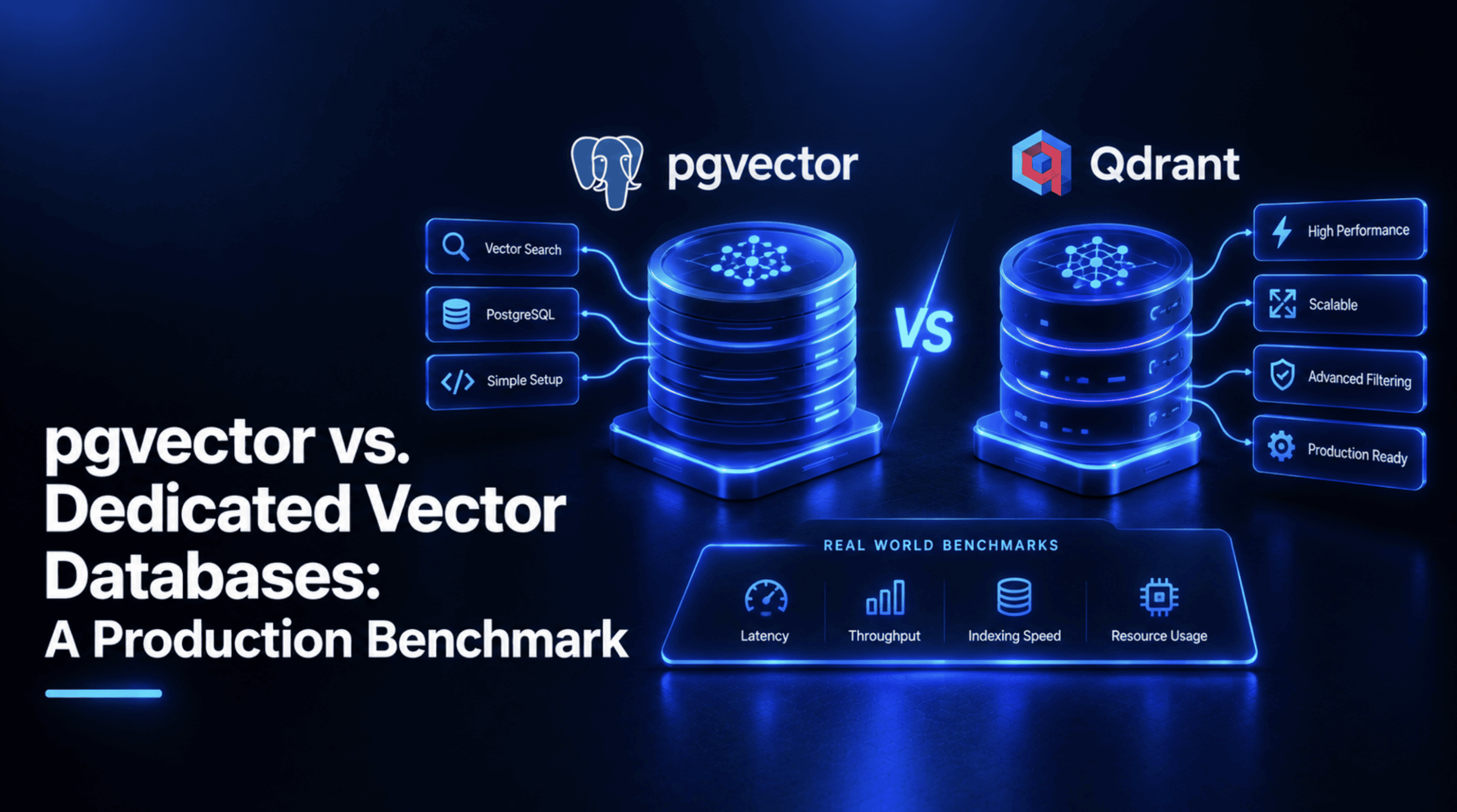
Notably, when utilizing PostgreSQL with pgvectorscale—an extension that introduces the StreamingDiskANN index—the performance profile changes significantly. In head-to-head testing against Qdrant, pgvectorscale demonstrated a massive lead in throughput, delivering over 470 queries per second (QPS) at 99% recall compared to Qdrant’s 41 QPS.
However, Qdrant maintained a superior tail-latency profile. Its p99 latency was nearly 50% lower than that of the pgvector configuration. This metric is critical for enterprise applications where consistent, low-latency responses are a strict Service Level Agreement (SLA) requirement. Furthermore, Qdrant completed the index build process for the 50-million-record dataset 3.4 times faster than the PostgreSQL-based solution.
Strategic Implications for Engineering Teams
The decision to migrate from a relational database with vector support to a dedicated vector engine should be predicated on specific business needs rather than general industry trends.
-
Transactional Integrity: If the application requires absolute atomicity—such as updating a user profile and its associated vector embedding in a single transaction—pgvector remains the superior choice. The overhead of ensuring consistency between two separate database systems often outweighs the performance gains of a specialized vector engine.
-
Tail-Latency Requirements: If the product architecture dictates that 99% of queries must return within a tight window (e.g., under 40 milliseconds), the tail-latency performance of specialized engines like Qdrant may justify the additional operational complexity of managing a second database.
-
Operational Maturity: For teams with deep expertise in PostgreSQL management, adding the pgvector extension is a low-risk, high-reward upgrade. Conversely, organizations without dedicated database administration resources may find that a managed, dedicated vector database like Pinecone reduces the total cost of ownership by eliminating the need for manual performance tuning and index maintenance.
-
Scale and Throughput: For datasets exceeding 100 million vectors, or for use cases involving massive concurrent search traffic, the distributed nature of systems like Milvus or the throughput capabilities of advanced pgvector configurations become essential.
Conclusion
The "pgvector vs. dedicated database" debate is rarely a binary choice between failure and success. Instead, it is a calculation of technical trade-offs. The data demonstrates that for the vast majority of applications, the performance of PostgreSQL with pgvector is more than sufficient. Its ability to handle both relational and vector data within a single, ACID-compliant transaction provides a unique architectural benefit that many developers underestimate.
However, the specialized performance profiles of dedicated vector databases—particularly regarding index build times and tail-latency consistency—serve a critical role at the extreme edges of scale and performance-sensitive workloads. As the AI ecosystem matures, the distinction between these categories is likely to narrow, but for now, the most effective engineering strategy remains a rigorous assessment of the specific query patterns, latency requirements, and operational capacities of the team in question. Avoiding the "vendor pitch" in favor of objective benchmarking ensures that infrastructure decisions support the long-term viability of the application rather than merely following the latest industry trends.
Related posts: