The Foundation of Vector Representations
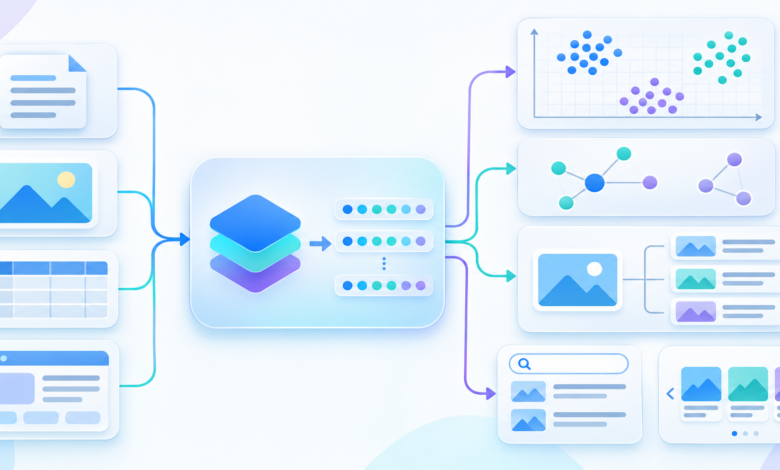
Modern AI architectures, including Large Language Models (LLMs) and retrieval-augmented generation (RAG) frameworks, do not process human language in its native form. Instead, they rely on embedding vectors—dense numerical representations that capture the semantic essence of words, sentences, or entire documents. By mapping semantic relationships into a multi-dimensional coordinate system, these models enable machines to perform mathematical operations on conceptual meaning. For example, in a well-trained vector space, the distance between the vectors for "king" and "queen" mirrors the relationship between "man" and "woman," allowing algorithms to compute logical semantic shifts.
The evolution of these models has progressed rapidly over the last decade. From the early days of Word2Vec and GloVe, which provided static, context-independent representations, the field has transitioned to transformer-based models that generate dynamic embeddings. These modern models account for word order and context, significantly improving the efficacy of downstream tasks such as semantic search, clustering, and automated classification.
The Mechanics of Model Selection
Selecting the appropriate embedding model is a multi-dimensional engineering challenge. Practitioners must evaluate models based on four primary differentiators:
- Embedding Dimensionality: The length of the output vector. Higher dimensions can capture more nuance but increase computational overhead.
- Context Window Size: The maximum number of tokens a model can process in a single pass. This is crucial for applications involving long-form content like legal contracts or academic papers.
- Training Methodology: The objective function used during training—such as contrastive learning or masked language modeling—which dictates whether a model is better suited for general similarity tasks or specialized information retrieval.
- Inference Latency: The time required to generate an embedding for a given input, which dictates the throughput of a production pipeline.
Infrastructure and Economic Implications
The operational cost of embedding pipelines is often overlooked until they reach production scale. The memory footprint of these systems is non-trivial. For instance, transforming one million documents into 1536-dimensional vectors using 32-bit floating-point precision requires approximately 6GB of raw RAM, excluding the overhead of the vector search index itself. When scaled to tens or hundreds of millions of documents, these requirements can lead to prohibitive cloud infrastructure costs.
To mitigate these expenses, the industry has widely adopted quantization—a process that reduces the precision of the numerical representations. Scalar quantization, which converts 32-bit floats into 8-bit integers, can reduce memory consumption by a factor of four with negligible impact on retrieval accuracy. More aggressive methods, such as binary quantization, collapse floats into single bits. While this provides a 32x reduction in memory, it is a lossy process that requires models to be specifically trained to handle binary output, making it suitable only for specific high-performance, lower-precision use cases.
A Chronology of Embedding Development
The history of embedding models is marked by distinct milestones that have shaped current industry standards:
- 2013: The introduction of Word2Vec by Google researchers, popularizing the concept of semantic vector spaces.
- 2017: The publication of "Attention Is All You Need," which introduced the Transformer architecture, fundamentally changing how context is represented.
- 2019: The rise of Sentence-BERT (SBERT), which utilized Siamese networks to create meaningful sentence-level embeddings, enabling efficient semantic search.
- 2021-2023: The emergence of specialized retrieval models like BGE (BAAI General Embedding) and E5, which are optimized specifically for RAG pipelines rather than general similarity.
- 2024-Present: The widespread adoption of quantization techniques and specialized hardware acceleration (such as FP8 support) to optimize embedding generation at the edge and in massive server-side deployments.
Benchmarking: A Practical Framework
To determine the efficacy of a model, practitioners must look beyond theoretical benchmarks and test against their specific datasets. A common and effective method involves using the silhouette score—a measure of how well a clustering algorithm separates data points. By using libraries such as scikit-learn and sentence-transformers, developers can create a robust testing harness.
In a controlled experiment using 500 documents from the 20newsgroups dataset, comparing the "all-MiniLM-L6-v2" model against the "BGE-Small" model reveals significant performance disparities. The MiniLM model, designed as a general-purpose lightweight model, achieved a silhouette score of 0.0909. In contrast, the BGE-Small model, which is optimized specifically for retrieval tasks, achieved a score of 0.1582.
This difference is not merely academic. The higher score indicates that BGE-Small effectively mapped the documents into clusters that align more closely with their actual topical labels. The implication for developers is clear: while generalist models are useful for quick prototyping, specialized retrieval models are superior for handling noisy, domain-specific data where semantic distinction is paramount.
Broader Impact and Future Implications
The integration of embedding models into corporate workflows represents a shift from keyword-based search—which is prone to missing relevant information due to synonymy or polysemy—to intent-based retrieval. This transition is the backbone of the current "GenAI" revolution, allowing enterprises to ground their LLMs in proprietary knowledge bases.
However, as the field matures, the challenge shifts from simply "getting it to work" to optimizing for cost, latency, and environmental impact. The adoption of open-weight models allows for local, private execution, which is a major regulatory requirement for industries like healthcare and finance. By running these models on local infrastructure, companies can ensure data sovereignty while maintaining high performance.
Conclusion
The selection of an embedding model is an architectural commitment. As models become more specialized and hardware continues to evolve, the ability to benchmark and optimize these components will remain a high-value skill for machine learning practitioners. By focusing on the interplay between dimensionality, quantization, and domain-specific performance, developers can build systems that are not only accurate but also sustainable and cost-effective. The trajectory of this technology suggests a future where embedding generation becomes a commoditized, highly efficient utility, allowing developers to focus on the higher-order logic of their applications rather than the underlying infrastructure.