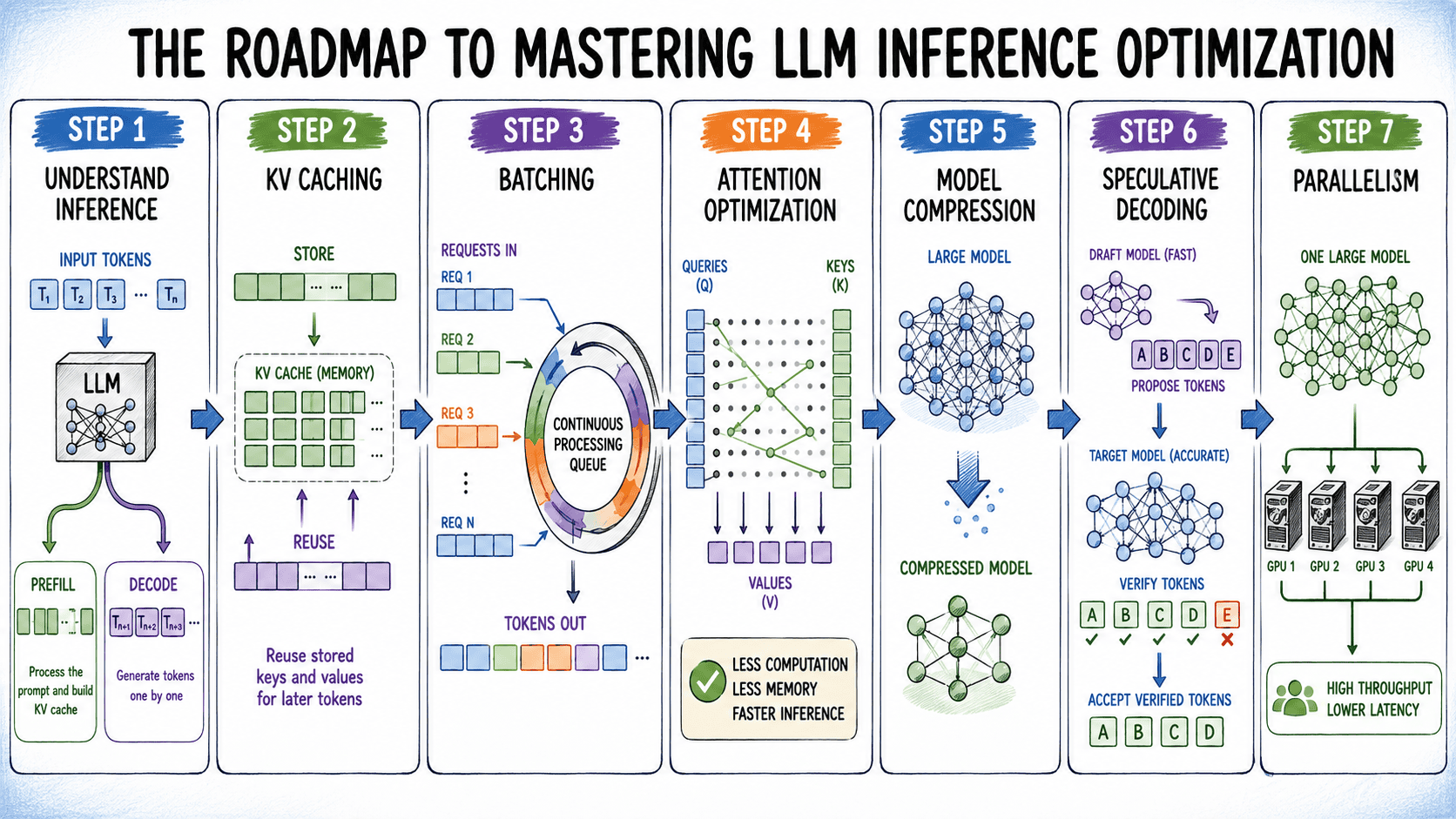
The Economic and Technical Imperative
The industry has reached a pivotal juncture where the cost per token is as critical as the model’s reasoning capability. Industry analysts estimate that for many AI-native startups, inference costs represent the single largest line item in the operational budget. Unlike training, which is a one-time capital expenditure, inference is a recurring operational cost that scales linearly with user adoption. Without rigorous optimization, organizations risk "compute bankruptcy," where the cost of serving a single query exceeds the value generated by the application.
This discipline of inference optimization focuses on closing the gap between raw hardware potential and actual delivered performance. By implementing architectural adjustments—ranging from sophisticated memory management to hardware-level parallelization—engineers can serve significantly higher volumes of traffic on identical hardware footprints.
Anatomy of the Inference Bottleneck: Prefill and Decode
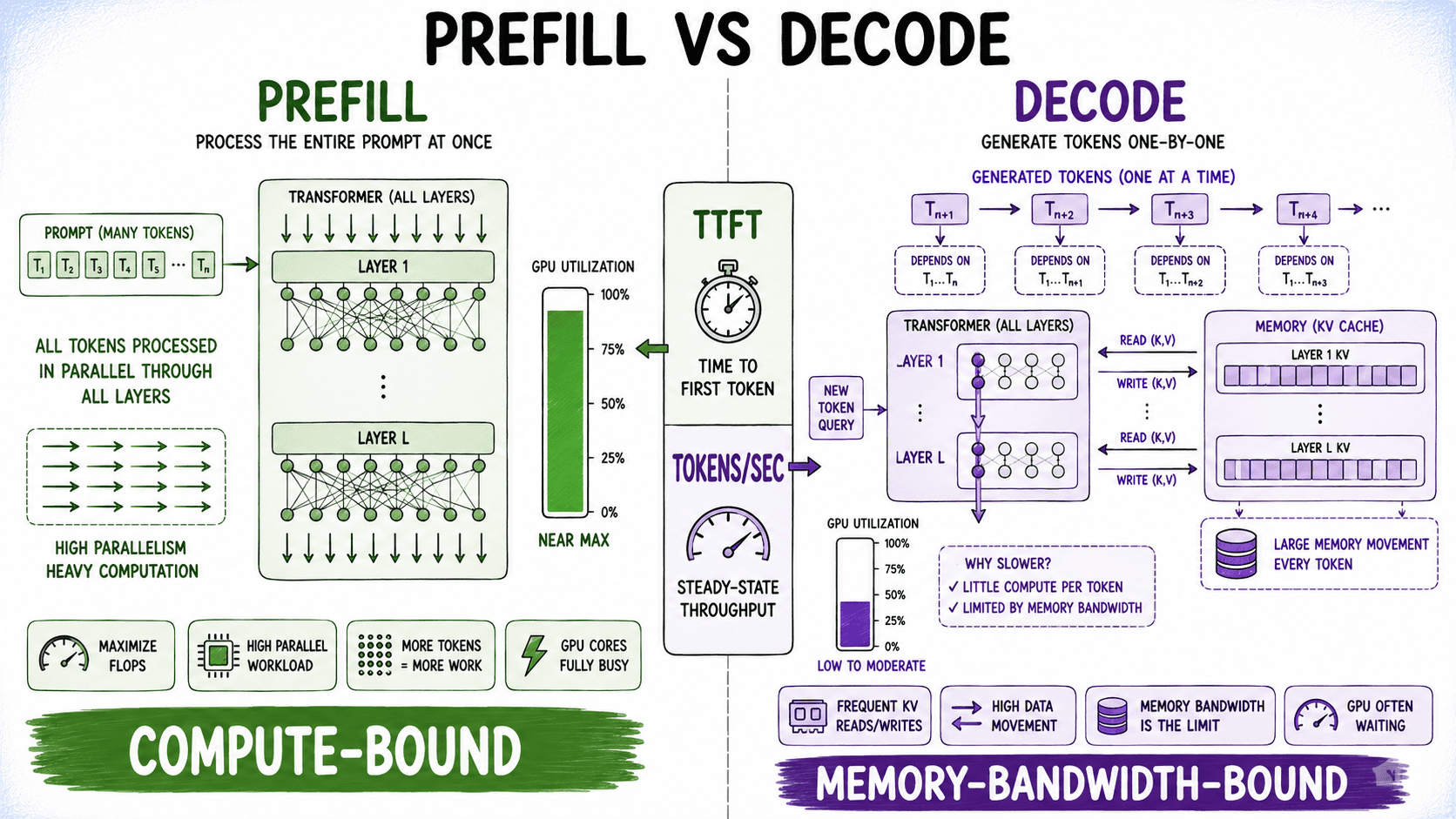
To understand how to optimize an LLM, one must first dissect the two-phase nature of the transformer inference process. When a user submits a prompt, the system enters the "prefill" phase. During this stage, the model processes the entirety of the input prompt in parallel. Because the input is fixed and known, this phase is compute-bound, meaning the speed is limited primarily by the raw TFLOPS of the GPU.
Conversely, the "decode" phase is entirely different. LLMs are autoregressive, meaning they generate one token at a time, with each token acting as the input for the next. This sequence cannot be parallelized. During decoding, the GPU is not bottlenecked by compute, but by memory bandwidth—the speed at which it can move weights and the KV (Key-Value) cache from VRAM into the processing cores. Consequently, standard performance metrics like Time-to-First-Token (TTFT) and Tokens-Per-Second (TPS) require distinct optimization strategies. Improving prefill speed does nothing to alleviate a slow decode cycle, and vice-versa.
The Evolution of KV Caching and Paged Memory
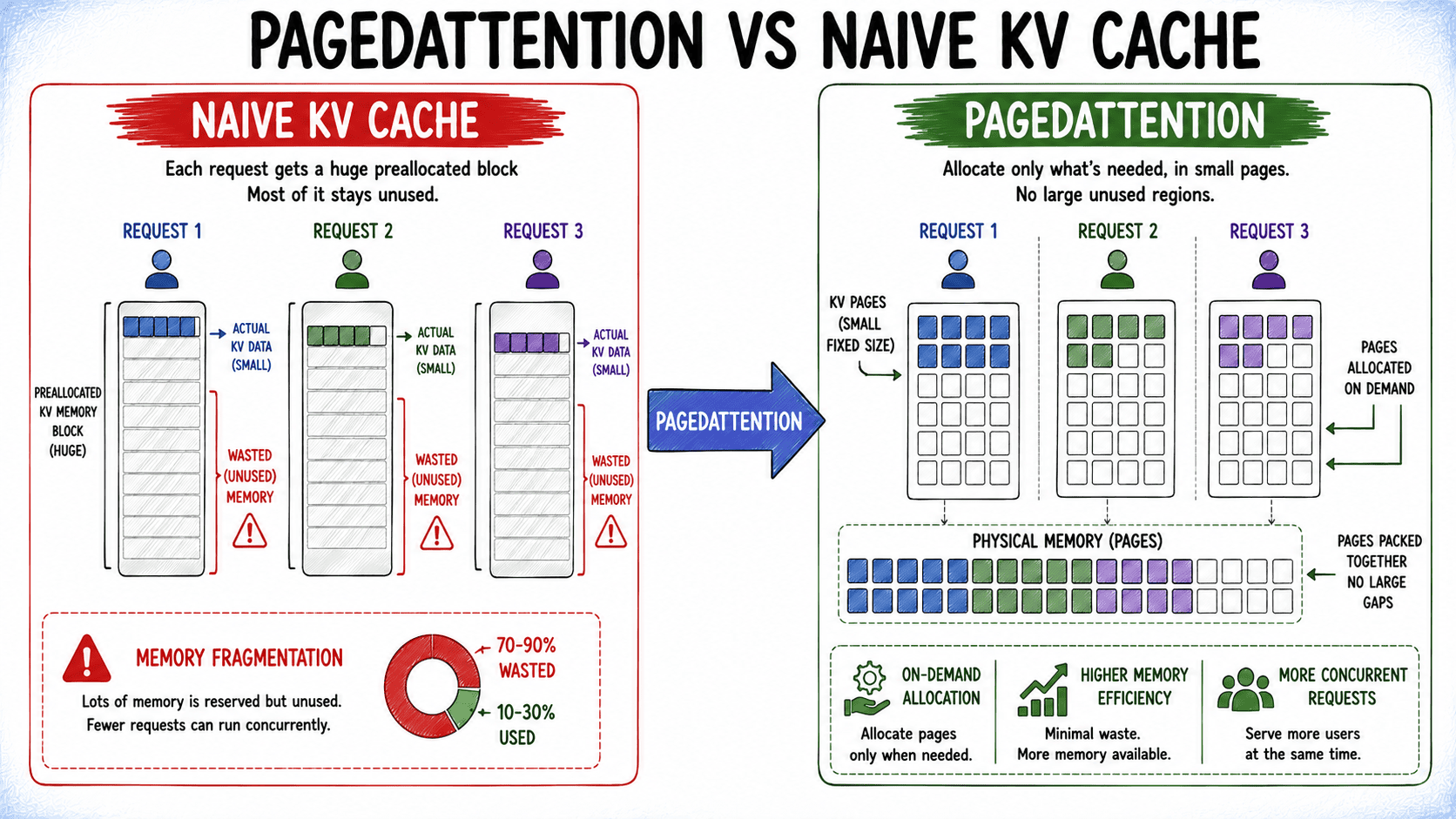
The KV cache is the engine of the decode phase, storing the intermediate states of previous tokens to prevent redundant calculations. However, in naive implementations, this cache grows linearly with sequence length and batch size, leading to severe memory fragmentation. If a system allocates memory based on the theoretical maximum sequence length, it leaves vast swathes of VRAM unused, effectively capping the number of concurrent users.
The industry standard has shifted toward PagedAttention, a technique inspired by virtual memory management in operating systems. By partitioning the KV cache into non-contiguous blocks, systems can allocate memory dynamically as tokens are generated. This prevents "internal fragmentation" and allows for significantly larger batch sizes. Similarly, prefix caching has emerged as a crucial optimization for RAG (Retrieval-Augmented Generation) pipelines. By caching the KV states of static system prompts or common document headers, companies can avoid recomputing millions of tokens, drastically reducing both latency and operational expense.
Continuous Batching: The Shift in Scheduling
Early inference engines relied on static batching, which forced the system to wait for a fixed number of requests before processing them together. This approach proved catastrophic in real-world scenarios where user requests vary in length. A single long-form request would hold up the entire batch, forcing shorter requests to wait idle.
The breakthrough was the implementation of "continuous" or "in-flight" batching. In this model, the scheduler operates at the individual token level rather than the request level. As soon as a single request completes its generation, the scheduler immediately inserts a new prompt into the empty slot. This keeps GPU utilization consistently high, regardless of the variance in prompt or output lengths. Modern runtimes, such as vLLM and TensorRT-LLM, have made this the baseline for production deployments.
Attention Mechanisms and Hardware Efficiency
The attention mechanism, while powerful, is computationally expensive. Research into more efficient attention variants has yielded significant dividends. Multi-Query Attention (MQA) and Grouped-Query Attention (GQA) reduce the memory footprint of the KV cache by having multiple query heads share a single set of key-value heads.
FlashAttention represents perhaps the most significant software-level breakthrough in recent years. By fusing the attention operation and utilizing high-speed on-chip SRAM to store intermediate calculations, FlashAttention minimizes the need for slow, high-latency trips to the GPU’s global VRAM. This technique is now considered a "must-have" implementation for any high-performance LLM stack, often providing speedups of 2x to 4x without sacrificing a single point of model accuracy.
The Role of Model Compression
Compression techniques—quantization, sparsity, and distillation—offer a path to running larger, more capable models on smaller, cheaper hardware. Quantization, specifically 4-bit and 8-bit integer precision, reduces the model’s footprint by up to 75% compared to the standard 16-bit floating point, often with negligible impact on output quality.
Furthermore, NVIDIA’s implementation of structured sparsity (the 2:4 pattern) allows for hardware-accelerated computation where half of the weights are effectively ignored, providing a direct boost in throughput. Knowledge distillation, while more labor-intensive, allows developers to transfer the "intelligence" of a massive teacher model into a smaller student model, creating a specialized tool that is both faster and cheaper to run.
Speculative Decoding for Latency-Sensitive Applications
For applications like real-time customer support bots or coding assistants, latency is the ultimate metric. Speculative decoding allows these systems to bypass the serial bottleneck of autoregressive generation. By using a small, "draft" model to predict the next few tokens and a larger, "verifier" model to check them in parallel, systems can effectively generate multiple tokens in the time it takes to generate one. If the draft model is accurate, the latency savings are immense; if it fails, the system reverts to the standard generation path, ensuring 100% correctness.
Scaling Through Parallelism and Disaggregation
When a single GPU is insufficient to house a model, or when the sheer volume of traffic necessitates a distributed approach, engineers turn to Tensor and Pipeline Parallelism. Tensor parallelism divides the weight matrices themselves across multiple GPUs, which is ideal for reducing latency. Pipeline parallelism, by contrast, splits the model vertically by layer, which is better suited for high-throughput batch workloads.
The frontier of this field is "prefill-decode disaggregation." Recognizing that prefill and decode have different hardware requirements, cutting-edge deployments are beginning to route these phases to separate clusters. Prefill clusters are equipped with high-compute hardware, while decode clusters are optimized for high memory bandwidth. This structural separation prevents long, heavy prompts from "clogging" the generation capacity of the decode cluster.
Implications for the Future of AI Infrastructure
The optimization of LLM inference is no longer an optional engineering task; it is a fundamental requirement for the viability of the AI economy. As models continue to grow in size and complexity, the ability to serve them efficiently will dictate which companies survive the transition to the next generation of computing. The trajectory of the industry indicates that we are moving toward a future of heterogeneous inference, where specialized hardware, intelligent scheduling, and algorithmic compression work in concert to make high-performance AI as ubiquitous and cost-effective as traditional web traffic. By mastering these seven layers of optimization, organizations can ensure that their AI initiatives are not only innovative but sustainable in the long term.