Optimizing LLM Workflows: How Markdown Data Output is Drastically Reducing Token Costs for AI Agents

The rapid proliferation of autonomous AI agents and large language model (LLM) workflows has brought an invisible operational expenditure to the forefront of software development: token consumption. While developers frequently focus on model selection, fine-tuning, and prompt engineering, the underlying data payloads consumed by AI agents during searches and file retrievals have quietly ballooned into a major cost driver. Every full-length file, raw log, comment block, and nested object fetched from the web introduces thousands of tokens into the context window. Worse still, recursive query loops executed by autonomous agents continuously compound these costs, charging developers for metadata, tracking links, and UI rendering elements that the underlying language model neither reads nor utilizes for reasoning.
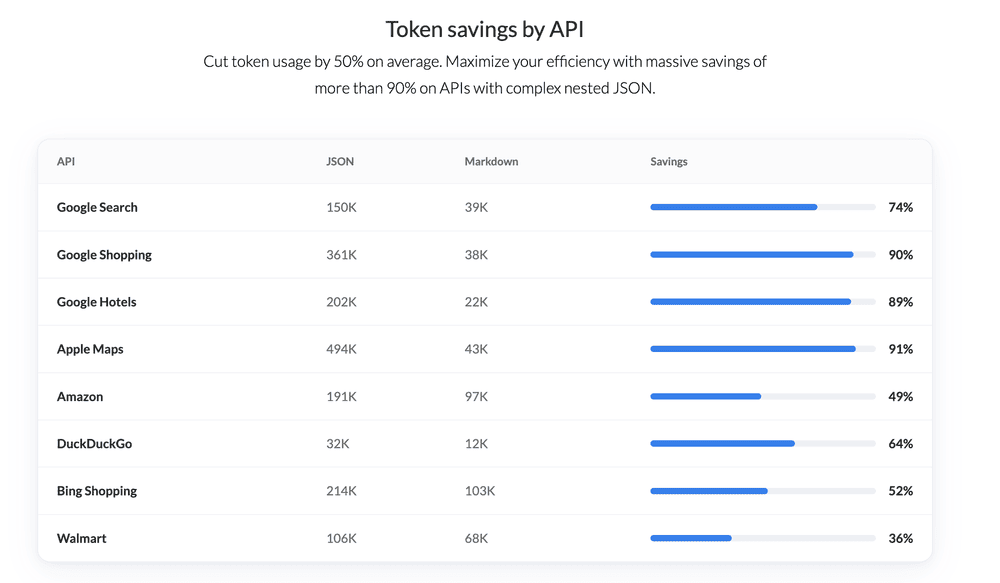
To combat this systemic inefficiency, infrastructure providers are beginning to pivot toward alternative data formats. A prominent development in this space is the recent introduction of native Markdown output capabilities by SerpApi, a move designed to radically trim token sizes for AI-driven applications. Industry benchmarks indicate that shifting data payloads from traditional JavaScript Object Notation (JSON) to Markdown can yield immediate token reductions exceeding 70 percent, fundamentally altering how developers manage context windows and API budgets.
The Anatomy of Token Inflation in AI Workflows
To understand the magnitude of the problem, one must examine how traditional search engine results and web scrapers deliver data to applications. For decades, JSON has served as the undisputed standard for data interchange across the web. Its strictly typed arrays, nested objects, and explicit key-value pairs make it exceptionally well-suited for programmatic consumption by traditional software, pricing engines, and automated analytics pipelines.
However, when a Large Language Model is introduced into the pipeline, JSON’s strengths quickly become liabilities. A standard API response for a simple query—such as looking up local coffee shops—often triggers a massive payload filled with redundant syntax. Brackets, quotation marks, internal tracking parameters, deeply nested metadata objects, and UI-specific identifiers are all parsed as individual tokens by the tokenizer.
When feeding this raw JSON into an LLM context window, the model receives a vast amount of structural noise. Although a human developer or a traditional compiler requires explicit data types and relational keys, an LLM primarily extracts semantic meaning, relative positioning, and raw textual relationships. Consequently, developers find themselves paying significant financial costs to transmit characters that contribute zero value to the model’s cognitive processing. In complex, multi-step agentic workflows—where an agent might execute dozens of searches per user request—this per-call bloat compounds exponentially, degrading overall system performance, exhausting context windows, and inflating cloud infrastructure bills.
The Markdown Alternative: Empirical Evidence and Efficiency Gains
The introduction of Markdown output represents a strategic shift in data delivery tailored specifically for neural networks. By stripping away programmatic syntax, structural boilerplate, and redundant tracking wrappers while preserving semantic hierarchy, Markdown offers a lean alternative that retains informational density without the overhead.
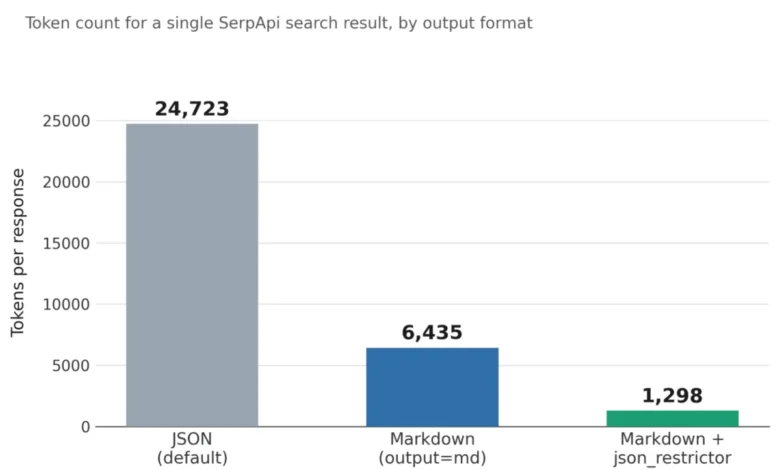
Empirical testing conducted by SerpApi illustrates the dramatic scale of these savings. In a controlled benchmark comparing output formats for a standard search query regarding "coffee," the conventional JSON response required 24,723 tokens to process. When the exact same search was executed using the newly introduced Markdown output, the required token count plummeted to 6,435 tokens. This represents a staggering 74 percent reduction in payload size.
Furthermore, the data indicates that additional server-side filtering and restricted field selections can drive the token requirement down even further—to a mere 1,298 tokens for a targeted, highly restricted view. Such efficiency gains carry profound implications for enterprise AI deployment. By freeing up vast swaths of the context window, developers can retain more conversational history, supply richer reference documents, or execute longer, more complex reasoning chains without hitting model token limits. Alternatively, the dramatic reduction in token consumption translates directly into substantial cost savings on commercial LLM API usage.
Technical Trade-Offs: When to Choose Markdown Versus JSON
Despite the undeniable advantages of Markdown in token-constrained AI environments, industry experts emphasize that it is not a universal replacement for JSON. Software architectures are nuanced, and the optimal data format depends heavily on the intended consumer of the payload.
Markdown output is heavily optimized for LLMs, autonomous agents, and conversational interfaces where semantic understanding and summarization take precedence. It utilizes native inline links, structured tables, and YAML frontmatter to convey information cleanly and concisely. However, it completely discards the strict data typing required by traditional backend codebases.
For engineering pipelines that rely on precise numeric values—such as exact float coordinates, strict integer pricing tiers, coupon calculations, or complex arrays intended for downstream relational databases—JSON remains the superior choice. For instance, a detailed e-commerce product query in JSON exposes explicitly typed fields such as integer prices, old prices, coupon values, and float ratings, alongside nested arrays for reviews and competing stores. This level of granular typing is indispensable for an automated pricing engine or a quantitative financial analytics job.
Conversely, an AI agent tasked merely with summarizing the top three products in a market segment does not require typed numerical objects. For that agent, Markdown’s clean table rows and inline links convey the necessary signal with a fraction of the token footprint. Developers must therefore architect their systems to dynamically serve JSON to traditional microservices while routing Markdown payloads directly to their LLM layers.
Implementation Strategies and Integration Mechanisms
Adopting token-efficient data formats has traditionally required complex parsing scripts, custom middleware, or regex-heavy data transformation pipelines built by the engineering team. However, modern API providers are integrating these solutions directly into their core routing infrastructure to minimize friction.
SerpApi has deployed its Markdown output capability across more than 100 specialized search APIs, ensuring universal availability without incurring additional subscription costs. Implementation is designed to be frictionless, requiring only minor adjustments to standard API calls. Developers can request Markdown output dynamically by appending a specific query parameter, modifying the route extension, or passing a designated header within the API request.
In addition to format conversion, advanced implementations often incorporate server-side field restriction tools—such as dedicated JSON restrictors or command-line interface flags—to pre-filter payloads before they ever cross the network boundary. By selecting only the specific data keys required for a given task at the server level, engineering teams can eliminate bandwidth waste alongside token bloat. This dual-layer optimization ensures that data transport remains lean, fast, and cost-effective across the entire application stack.
Industry Implications and the Future of Agentic Workflows
The emergence of token-optimized data formats signals a broader maturation phase in the artificial intelligence industry. As companies move beyond proof-of-concept deployments and scale their autonomous agent operations to enterprise levels, cost management and operational efficiency have emerged as critical success factors.
Historically, optimization efforts in machine learning focused almost exclusively on model quantization, weight pruning, and hardware acceleration. The growing focus on payload architecture highlights a growing recognition that data transmission and token economics are equally vital components of a sustainable AI ecosystem. Every superfluous bracket, tracking parameter, and unoptimized search result represents a friction point that dampens the velocity of intelligent systems.
As autonomous agents assume more complex responsibilities—ranging from automated software engineering and dynamic market research to comprehensive enterprise data retrieval—the demand for streamlined, model-native data formats will only intensify. While Markdown may eventually be supplemented or succeeded by even more compact serialization formats designed specifically for neural architectures, it establishes an important precedent: the structural shape of data must evolve to match the cognitive nature of the consumer.
For developers and organizations seeking to optimize their AI infrastructure, auditing token consumption across API boundaries has transformed from an optional best practice into an essential engineering discipline. By critically evaluating how data flows from search engines and document repositories into language models, teams can unlock immediate cost reductions, enhance agent reliability, and build more resilient, scalable artificial intelligence applications for the future.
Related posts: